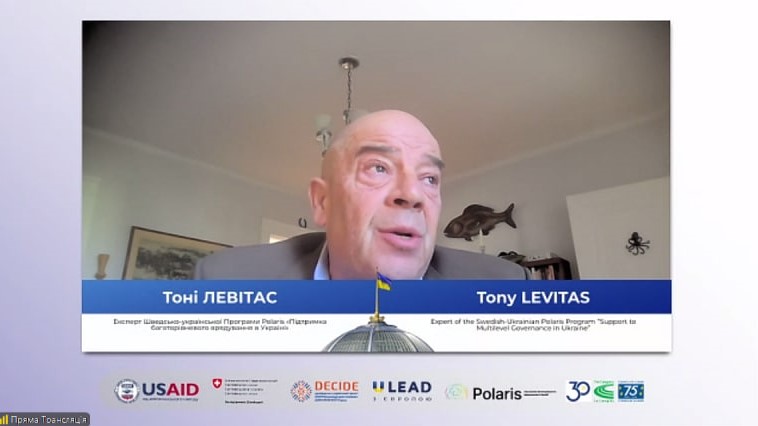
Tony Levitas, Senior Research Fellow at the Watson Institute for International and Public Affairs at Brown University (USA) and an expert with the Polaris Programme, participated in the Bucha Forum “Reforms. Decentralisation. European Integration”.
In his speech, he emphasized that Ukraine has made significant progress in reforming its local self-governance system, driven by the Local Self-Governance Reform Concept adopted in 2014. However, further changes and improvements in the multilevel governance system will require amendments and the development of a clearer vision for the levels of self-governance in Ukraine, along with a well-defined distribution of powers between state authorities and local self-governance bodies, as well as among various tiers of governance.
Levitas pointed out that Ukraine is already facing a shortage of qualified personnel, and establishing an effective three-tier governance system may prove to be an overly complex and resource-intensive endeavor.
He also highlighted the challenges in defining the powers assigned to each level of government. This issue is difficult to address without an agreed-upon concept that outlines the number of governance levels, their functions, and interrelations. This challenge becomes particularly pressing in the post-war period. Antony Levitas emphasized that the Concept must be tailored with a special focus on strengthening the capacity of local self-governance, which should serve as the foundation for the recovery and further development of hromadas.
Also, during his speech at the event "Problematic Issues in Executing/Planning Local Budgets for 2024–2025" organised by the All-Ukrainian Association of Amalgamated Hromadas, Tony Levitas emphasised the importance of reforming the personal income tax (PIT) system. The expert noted that the current mechanism for PIT allocation creates significant challenges for local budgets.
He underlined that Ukrainian hromadas could benefit from adopting the practices of most European countries, where PIT is paid based on the taxpayer's place of residence (with Romania being an exception). Tony Levitas further stressed that this reform is closely linked to the country’s democratic transformation, particularly in light of citizens returning to their communities after the war:
People returning home after the war need to be aware of their opportunities to influence local self-government and be confident that their taxes will be allocated to the level they voted for.
The expert stressed that addressing this issue requires collective efforts, but without political will, progress cannot be made.
It is important to note that the state must have a mechanism to regulate the payment of PIT by separate divisions of large companies. This is not a matter for the companies to decide but for the state. Implementing PIT reform during the war is challenging, but it must become a top priority when peace is restored.
These expert proposals are part of a broader discussion on rebuilding hromadas and creating a financially sustainable model of self-government that meets Ukraine’s needs in the post-war recovery period.
The Bucha Forum “Reforms. Decentralisation. European Integration” was organized by the Verkhovna Rada Committee on State Building, Local Governance, Regional Development, and Urban Planning with the support of the USAID Project 'Governance and Local Accountability (HOVERLA),' the Swiss-Ukrainian Project DECIDE – 'Decentralisation for Improved Democratic Education,' implemented with the support of Switzerland, the 'U-LEAD with Europe' Programme, the Swedish-Ukrainian Polaris Programme 'Supporting Multilevel Governance in Ukraine,' and the Council of Europe Programme 'Strengthening Good Democratic Governance and Resilience in Ukraine.'